Statement from the Canadian Pugwash Group on the U.S. “Golden Dome” Initiative
As the Government of Canada considers its response to the United States’ proposed “Golden Dome” missile defence initiative, the Canadian Pugwash Group reiterates its opposition to Canadian participation in the strategic ballistic missile defence components of this project, while acknowledging the need for prudent investments in early warning, conventional air defence, and arms control–based risk reduction.
President Trump’s “Golden Dome” proposal envisions a multilayered missile defence system, including space-based interceptors intended to detect, intercept, and destroy nuclear-armed intercontinental ballistic missiles during all phases of flight — boost, mid-course, and terminal. The initiative also seeks to address conventional missile threats, including hypersonic and cruise missiles, as well as aircraft attacks. This breadth has contributed to public and political confusion.
The Canadian Pugwash Group is deeply concerned that strategic missile defence leads adversaries to doubt the effectiveness of their deterrent forces and prompts them to reject arms control and potentially to expand their strategic arsenals, driving a heightened nuclear arms race.
Canada has previously declined participation in U.S. strategic ballistic missile defence initiatives, notably during the Strategic Defense Initiative debates of 1985 and again in 2005, when the Government of Canada chose not to join the U.S. ground-based mid-course missile defence system. Those decisions were grounded in concerns about technical feasibility, fiscal responsibility, strategic stability, arms control, and the risks associated with the weaponization of outer space. Those considerations remain fully applicable today.
There are three principal reasons why Canada should again decline participation in strategic ballistic missile defence under the Golden Dome initiative.
Strategic ballistic missile defence remains technically uncertain and fiscally unsound
Despite more than two decades of research and expenditures estimated at roughly US$250 billion, U.S. efforts to develop even limited ground-based strategic missile defence capabilities have demonstrated persistent technological limitations. Golden Dome represents a dramatic expansion of this unsound approach, relying on large constellations of space-based interceptors that would themselves be highly vulnerable to relatively inexpensive anti-satellite capabilities already possessed by major powers.
Cost estimates vary widely. While President Trump has cited an overall price tag of approximately US$175 billion, analyses by the U.S. Congressional Budget Office suggest that space-based components alone could exceed US$500 billion over two decades. Canada’s projected share has been publicly cited at roughly US$71 billion, or approximately CAD $96.5 billion — a scale of expenditure difficult to justify given competing defence, security, and societal priorities.
Strategic ballistic missile defence is destabilizing and undermines global security
Because offensive ballistic missile systems are far cheaper and easier to expand than defensive interception systems, adversaries can respond simply by increasing the size or sophistication of their arsenals. Concerns that U.S. missile defence developments could eventually threaten the credibility of China’s nuclear deterrent have already contributed to China’s move away from a minimum deterrence posture and toward a significant expansion of its nuclear forces. China has also announced efforts to develop its own missile defence capabilities, further complicating deterrence dynamics.
A large-scale expansion of U.S. strategic ballistic missile defence risks triggering a new and destabilizing nuclear arms race, undermining prospects for renewed arms control agreements, and weakening the foundations of strategic stability at a time when nuclear risks are already increasing.
Weaponization of outer space would pose serious global risks
The deployment of weapons in space, which Canada has long and explicitly opposed, would endanger both civilian and military satellite infrastructure through debris generation, interference, and direct destruction. Disruption of space-based systems would threaten essential global services, including communications, navigation, financial systems, weather forecasting, and environmental monitoring, with far-reaching consequences for international security and economic stability.
NORAD modernization and early warning remain appropriate Canadian priorities
The Canadian Pugwash Group distinguishes these concerns over Golden Dome from Canada’s existing and appropriate commitments to NORAD modernization. Investments in enhanced early warning systems, aerospace surveillance, and conventional air defence — including defences against cruise and hypersonic missile threats — represent prudent measures grounded in proven technologies and realistic threat assessments.
For national security, sovereignty, regional stability, and ultimately war prevention, citizens and allies must have confidence both in the absence of threats and in the reliability of early warning should threats arise. Canada’s investments in these areas are consistent with responsible defence policy and do not require participation in strategic ballistic missile defence.
Defence, the security dilemma, and the central role of arms control and diplomacy
Even conventional defensive measures can generate security dilemmas if pursued in isolation. The pursuit of effective defences against cruise and hypersonic missiles may incentivize adversaries to expand their offensive arsenals at lower cost, leaving all parties less secure, despite higher levels of armament.
Historically, meaningful reductions in nuclear risk have depended not only on military capabilities but on sustained diplomacy and arms control. During the Cold War, ongoing engagement between adversaries enabled mutual recognition of the need for restraint and produced agreements limiting nuclear arsenals despite intense geopolitical rivalry.
Canada has previously played a constructive role in this regard. For example, then FM Joe Clark, in a January 1985 House of Commons debate on the U.S. Strategic Defence Initiative, warned of the “serious implications for arms control if space-based ballistic missile defence systems were developed and deployed”. In 2005, then Defence Minister Bill Graham, in a letter to the Canadian Pugwash Group explaining Canada’s decision not to participate, stated that: “Canada’s principal approach to address threats posed by missiles is prevention, through non-proliferation, arms control and disarmament (NACD) measures.”
The Canadian Pugwash Group believes that Global Affairs Canada should again play this role, providing clear-eyed analysis of the implications of Golden Dome for strategic stability and arms control and ensuring that defence decisions are embedded within a broader diplomatic and risk-reduction framework.
Comparable diplomatic effort will be required today to address emerging risks associated with strategic, hypersonic, and cruise missile systems, particularly in sensitive regions such as the Arctic. Accordingly, the Canadian Pugwash Group calls on the Government of Canada to situate its NORAD modernization efforts within a broader security-building framework that includes:
- tasking the Minister of Foreign Affairs to pursue sustained discussions with allies and adversaries aimed at easing tensions and promoting arms restraint, particularly regarding cruise and hypersonic weapons and Arctic security;
- supporting the resumption of strategic arms limitation and nuclear risk reduction dialogue among the United States, Russia, and China and, to the extent possible, other nuclear-armed states;
- reaffirming Canada’s commitment to preventing the weaponization of outer space and strengthening international norms in this domain.
Canada has historically played a constructive role in advancing arms control, strategic stability, and risk reduction. Declining participation in strategic ballistic missile defence under the Golden Dome initiative, while updating Canada’s air and non-strategic missile defenses and intensifying diplomacy, would be consistent with that tradition and would enhance both Canadian and global security.
March 3, 2026
Contact Canadian Pugwash Group
Cesar Jaramillo, CPG Chair. cesar@sanepi.org
Peggy Mason, CPG Vice-Chair. pmason@rideauinstitute.ca




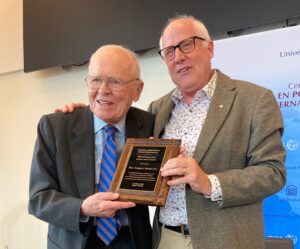 Photo (at left) of presentation of award by Alex Neve O.C., Chairperson, Canadian Leadership for Nuclear Disarmament to the Hon. Douglas J. Roche O.C. on October 23, 2025.
 The author is a member and past Chair of Canadian Pugwash Group